
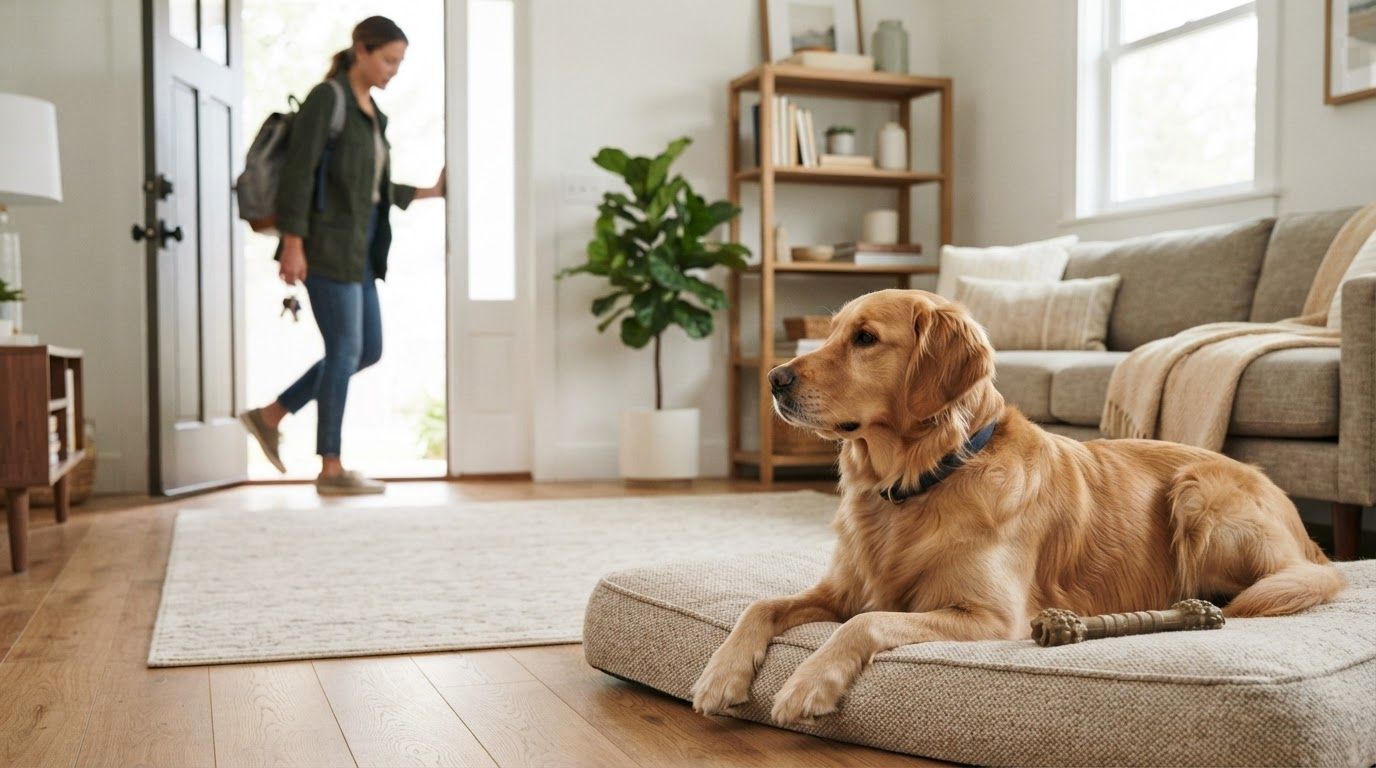
If your dog has spent years beside you while you worked from home, a return to the office can make an ordinary departure feel like a big change. Dog alone time training helps rebuild the habit of relaxing without you, starting with absences short enough for your dog to handle comfortably.
Even a dog who used to stay home happily may need a refresher after a long stretch of constant company. The goal is not to force independence in a single weekend; it is to observe what your dog can manage, practice gradually, and arrange support when your work schedule moves faster than training does.
What dog alone time training involves
Start with an absence so brief that your dog remains comfortable, return before distress builds, and repeat. Gradually increase the time only when your dog is consistently relaxed, and arrange company or care for longer absences while you train.
That short pattern is the foundation of retraining. It applies whether your dog follows you from room to room, worries when you pick up your keys, or has trouble settling once the front door closes. The important detail is that the starting point belongs to your dog, not to a schedule you found online.
For one dog, the first useful step may be standing outside the door for a moment. For another, it may be walking a few steps away while the dog remains on a bed. If your dog cannot stay relaxed during an actual departure, begin with an easier version instead of repeating an absence that causes distress.
The ASPCA explains that a sudden routine change, including going from a guardian working at home to being left alone for six or more hours, can contribute to separation anxiety. That does not mean every dog who dislikes a new schedule has an anxiety disorder. It does mean that a dog who previously managed alone time may need help adjusting again.
Think of training and daily care as two connected jobs. Training builds your dog's ability to cope with short separations. Daily care prevents your dog from having to face an absence that is much longer or more difficult than they can currently handle. Both matter when your office schedule is approaching.
There is no promise that a particular number of practice sessions will prepare every dog for a full workday. A dog who can settle for a short practice departure is making progress, but that success is not yet proof that a long office day will be comfortable. Build from what you can observe rather than assuming the next jump will be easy.
Recognize whether your dog is struggling when left alone
Before setting a training plan, look at what happens before you leave and while you are gone. VCA notes that dogs with separation anxiety may stay close to their owners and follow them from room to room. Following you alone does not establish a diagnosis, but a change in that behavior can be useful information to share with your veterinarian.
The ASPCA and VCA describe several behaviors that may appear when a dog is distressed by being alone:
- Barking or howling during an absence.
- Chewing door frames or other areas near an exit.
- Digging at doors or trying to escape.
- Urinating or defecating indoors when left alone.
Context matters. A chewed object or an indoor accident does not, by itself, tell you why it happened. Note whether the behavior occurs specifically around departures or while your dog is alone, and tell your veterinarian about other changes you have noticed.
Watch the departure, not just the aftermath
If you have a way to record or watch your dog safely, observe a brief, planned absence. A camera can show whether your dog settles after the door closes, stays close to the exit, vocalizes, or begins trying to get out. It can also help you spot the difference between a dog who takes a toy to a resting place and a dog who leaves it untouched while watching the door.
Write down what you did before leaving, how long you were gone, and what you observed. You do not need an elaborate spreadsheet: a note such as “picked up keys, stepped outside briefly, dog stayed on bed” gives you a starting point for the next session. If you see distress, record that too and make the next attempt easier.
A recording is especially useful because you cannot assume your dog is relaxed simply because the house is quiet when you return. Equally, finding damage later does not tell you exactly when it happened. Observations from the absence itself give you and a professional more useful information than a guess based on the aftermath.
If you see intense escape attempts, injury, persistent signs of distress, or repeated elimination, contact your veterinarian rather than treating the situation as a basic obedience problem. Your vet can help assess what is happening and guide the next steps.
Build independence while you are still at home
Years of working together may have made your presence part of your dog's normal resting routine. You can begin changing that pattern before you leave the house. VCA describes independence training and a downtime exercise as ways to help a dog practice calm time without constant access to the person they are attached to.
Start when your dog has had a chance to meet their needs and is likely to settle. Choose a comfortable resting area and make the exercise easy enough that your dog does not need to follow you. The aim is a relaxed dog, not a dog who has been made to remain in a particular spot while upset.
- Invite a calm pause. Encourage your dog to settle on a bed or another comfortable spot while you remain nearby. You can use a familiar, suitable chew or food toy if your dog enjoys it and can use it safely.
- Move a little. Take a small step away, then return while your dog is still comfortable. Repeat without making the movement into a dramatic event.
- Add ordinary movement. Walk a few steps around the room or briefly out of sight, returning before your dog becomes worried. If your dog gets up and follows, make the next repetition easier.
- Practice in daily life. Once the simple version is comfortable, use short moments when you make a cup of coffee, put laundry away, or move between rooms.
There is no need to turn every trip across your home into a formal lesson. A few manageable opportunities can fit naturally into a day, and stopping while your dog is still relaxed makes the next practice more useful than pushing until they are upset.
Pay attention to your dog's preferred resting places. If the bed you chose leaves them staring at a doorway, another location may be easier. The best setup is the one in which your dog can settle, not necessarily the spot that looks most convenient from your desk.
For service dog handlers, independence practice does not have to mean abandoning the bond or changing working routines all at once. Choose a time when your dog is off duty and you can safely practice a small separation. Adapt the exercise to your needs and the dog's normal responsibilities; if that is difficult, a qualified professional can help tailor the plan.
Practice short departures before returning to the office
Once your dog can handle the easiest separation exercises, practice the actual pieces of leaving. AKC recommends trying your normal workday morning routine and leaving briefly before the real return-to-office day. This gives you a chance to find out which parts of the routine your dog notices and which steps need more practice.
Separate the departure cues from the departure
Shoes, keys, a bag, and a particular jacket can all be part of the sequence your dog associates with being left. Practice ordinary versions of those actions without always following them with a long absence. For example, pick up your keys and put them down, or put on your shoes and then continue your day at home.
Watch your dog's response rather than racing through the routine. If picking up a bag makes your dog immediately follow or appear unsettled, pause at that level and make it easier. You may need to work on one cue at a time before combining several cues with opening the door.
Use the door as a training step
When your dog is comfortable with the preparation, approach the door, open it, and return to your usual activity. Then try stepping outside and coming back before your dog becomes distressed. At first, the interval may be extremely short; that is a legitimate starting point.
Repeat the easy version, using a camera if available to check what happens after the door closes. When your dog is consistently relaxed, extend the absence in small increments. You do not have to increase the time every session. An easy repetition can be helpful practice, especially when you are also changing something about the routine.
If your dog becomes distressed, do not scold them or simply keep them alone to see whether they get used to it. Return, make a note of what happened, and plan an easier next attempt. The ASPCA recommends increasing absences gradually without exposing the dog to the full intensity of the anxiety trigger, and notes that choosing when to extend the time can be difficult.
Keep your own movements calm and ordinary. AKC notes that dogs can pick up on human anxiety; a matter-of-fact departure can make the routine easier to practice. This is not about blaming yourself if your dog struggles. It is about making each rehearsal predictable and giving yourself enough time that you are not rushing through it.
Once short practices go well, vary everyday details thoughtfully. Try the bag you actually take to work or the door you normally use. Change one element at a time when possible, so you can tell whether the new version remains comfortable. If it does not, return to a simpler version before adding more difficulty.
Set up a comfortable space without relying on a crate
Your dog's alone-time area should be a place where they can rest safely and comfortably. Depending on the dog and your home, that might be a familiar room or another dog-safe area. Check access to water, remove obvious hazards, and choose a setup that fits your dog's actual behavior rather than an idealized picture of where they should settle.
A crate is not automatically the right answer for a dog who struggles with separation. VCA warns that crating can intensify escape attempts in some dogs with separation anxiety and may lead to injury. If your dog scratches frantically at a crate, tries to force their way out, or seems more distressed inside it, ask your veterinarian for guidance on a safer arrangement.
Some dogs already rest comfortably in an open crate, while others do better with a different space. Observe the dog in front of you. Do not introduce confinement as a quick fix for a return-to-office problem, and do not assume that limiting movement will address the underlying distress.
Use food toys as a helper, not a test your dog must pass
AKC suggests puzzle and chew toys as ways to provide engagement during alone time. A familiar food-stuffed toy can be part of a pleasant departure routine for some dogs, but the ASPCA notes that this approach generally works best for mild separation anxiety. A highly anxious dog may not eat while alone.
Offer a toy you have already seen your dog use safely, and consider whether it is appropriate to leave with your particular dog without supervision. If you are unsure, ask your veterinarian. Avoid introducing an unfamiliar item for the first time just as you leave for an important appointment.
Notice what happens to the toy, but interpret it alongside the rest of your observations. A dog who ignores food and watches the exit may need an easier absence; a dog who eats the food is not automatically ready for an entire workday. The toy supports the plan, while the dog's overall comfort guides the pace.
Keep your setup practical for your household. If your dog settles best away from a frequently used doorway, try that area during an easy practice session. If you are uncertain whether a space is safe or whether confinement is contributing to the problem, review your observations with your veterinarian before extending absences.
Plan exercise and care around your real workday
A predictable morning can make the transition easier for both of you. AKC recommends at least 15 minutes of vigorous play or a walk before departure to help a dog use excess energy. Treat that as a starting idea to discuss and adapt, not a requirement to push every dog through the same workout.
Your dog's age, health, fitness, and preferences matter. A walk that suits an active adult dog may not suit a puppy, senior dog, or dog with a medical condition. Ask your veterinarian what activity is appropriate if you are unsure, and allow time afterward for your dog to drink, settle, and have a bathroom opportunity before you practice leaving.
For Phoenix-area owners, plan outdoor activity with the conditions in mind. Choose a cooler part of the day when possible, pay attention to your dog and the walking surface, and use indoor activities as an alternative when outdoor exercise is not a sensible choice. A food puzzle or gentle indoor game may fit into the routine, although enrichment does not replace gradual separation training.
Make a bridge plan for absences
The biggest practical challenge is often the gap between what your dog can handle today and the hours you need to be away. If your dog is comfortable only with very short departures, a full office day is not the next training step. Look for ways to provide company or care while you continue practicing.
- Ask someone your dog knows to help. A family member, friend, or neighbor may be able to stay with your dog for part of your absence.
- Explore professional care. A pet sitter or another appropriate care option may help cover time you cannot be home. Check that the arrangement suits your dog's needs and comfort.
- Adjust the workday if possible. A gradual return, a shorter day away, or help from another household member may reduce the size of the immediate change.
- Coordinate training and coverage. Use short, planned departures for practice rather than counting an unavoidable long absence as a training session.
These choices involve trade-offs. Paid care has a cost, family help depends on availability, and a busy care environment may not suit every dog. The best bridge plan is one you can realistically arrange and that keeps your dog comfortable while their skills develop.
If a long absence cannot be avoided, tell your veterinarian or behavior professional about the schedule rather than hiding it. They can help you prioritize a realistic plan. The goal is to reduce distress as much as you can, not to make an already difficult transition a source of guilt.
Know when to call your veterinarian or a behavior specialist
Professional help is appropriate if your dog repeatedly panics, attempts to escape, damages exits, vocalizes, or eliminates when alone. AKC recommends consulting a veterinarian or veterinary behaviorist because separation-related problems may need a different approach from other behavior concerns. Get guidance promptly if escape attempts could cause injury.
Bring the information you have collected: when the behavior happens, what the departure looked like, how long your dog was alone, and any video you can safely obtain. Also describe your dog's daily routine and any recent changes. Your veterinarian can use that information to help assess the problem and discuss a plan.
Discuss training, environment, and medication together
VCA notes that veterinarians can recommend training techniques and, when appropriate, calming supplements or medications. Medication can be helpful for some dogs as part of a broader plan, but it is not a substitute for teaching your dog to cope with separation. VCA also cautions that tranquilizers alone may sedate a dog without reducing the anxiety.
Ask what the recommended treatment is intended to do, how you should monitor your dog, and how the training plan should fit around it. Do not give your dog a product or medication based solely on another owner's experience. Your veterinarian is the right person to discuss whether an option is appropriate for your dog.
AVMA advises against punishing signs of anxiety. If you come home to a mess or damage, focus first on your dog's safety and on arranging an easier plan for the next absence. Punishment does not teach the calm independence you are trying to build.
Professional support can also be valuable before the situation becomes severe. If you are unsure how to choose a starting point, cannot tell when to lengthen a departure, or need a plan that works around service-dog responsibilities, ask for individualized help. Good guidance should fit your dog and your household rather than asking you to follow a fixed timetable regardless of the response.
Track progress without rushing the next absence
Progress is more useful when you can describe it. Instead of writing only “better,” record what your dog did: settled on a bed after you stepped outside, remained comfortable while you picked up keys, or followed you when you moved toward the door. These details help you choose the next manageable exercise.
Review your notes for patterns. A dog may handle a short absence after a quiet morning but find the same departure harder when several routine changes happen together. That does not erase the earlier success; it tells you that the second situation may need its own easier starting point.
Before increasing difficulty, ask yourself a few practical questions:
- Was my dog relaxed throughout the current version, including after the door closed?
- Did I repeat the exercise successfully, or am I increasing the time after a single attempt?
- Am I changing only the duration, or am I also adding keys, a bag, a different exit, or another new detail?
- Do I have a care plan for any absence that is longer than my dog can currently manage?
If the answer suggests the next attempt may be too difficult, make it smaller. You can shorten the time, remove a departure cue, or return to an in-home independence exercise. The ASPCA cautions that deciding when to extend absences is difficult, so adjusting the plan is part of training rather than a sign that you have failed.
Keep your expectations tied to your dog's observed response. A successful brief departure is a useful building block, not a deadline for reaching a particular number of hours. Celebrate the practical wins: a calmer morning routine, a dog who rests while you move around, or a comfortable practice exit that used to be difficult.
Over time, your notes can also make conversations with your veterinarian more productive. Bring both the successful sessions and the difficult ones. Knowing what your dog can already do comfortably gives you a foundation for deciding what to practice next.
Returning to work away from home does not have to mean expecting your dog to switch immediately from constant company to a long day alone. Begin with comfortable independence at home, rehearse your real departure in small pieces, and use your dog's behavior to decide when to advance.
Arrange care for the gap between training and your actual schedule, and contact your veterinarian if your dog shows persistent distress or unsafe escape behavior. With a patient plan and the right support, you can help your dog rebuild a calmer alone-time routine.


